

Predicting recovery. Connecting care.
Decision support and care coordination for the weeks after hospital discharge.
Patient R.M. · Day 6 after discharge
62
Medium risk- Mobility reduced against baseline
- Two missed medication check-ins
- Reported low confidence at home
Queued for coordinator review · 14:20
Discharge is not the same as recovery
A patient can be medically fit to leave hospital and still be at risk. Responsibility spreads across family, GPs, community nurses, pharmacies and support providers — with no single view of how recovery is actually going.

47.5%
received enough support after leaving hospital
32%
felt unprepared when they were discharged
18%
were contacted afterwards to assess their support needs
A review of 23 studies found that inadequate social support after discharge was associated with increased readmission risk. When patient information, family concerns and referrals sit in separate systems, deterioration can be missed and no shared record of action exists.
One pathway, from information to action
Ambrosia turns structured recovery updates into prioritised, human-reviewed action, and records what happened — so every risk event has a traceable outcome.
Onboard
Consent is secured and the patient's recovery profile is created: reason for discharge, recovery goals, expected pathway, known vulnerabilities, existing support and nominated contacts.
The PRSO Engine
Predictive Risk Stratification and Optimisation
PRSO combines five domains of recovery information, compares them against each patient's own baseline, and produces a visible score, an explainable set of reasons, and a defined review priority.
Baseline and recovery context
Reason for discharge, recovery goals, expected pathway, known vulnerabilities, existing support and nominated contacts.
Symptoms and change
Pain, fatigue, wounds, new concerns, and whether symptoms are improving, stable or deteriorating.
Medication and daily function
Medication concerns, adherence, mobility, daily activities, nutrition and hydration.
Behavioural and social context
Mood, confidence, isolation, family observations, home safety and access to practical support.
Optional health observations
Manually entered or connected-device readings, supported by range, trend, missing-data and quality checks.
The assessment is strengthened by how these signals interact. A single symptom in isolation says little; a symptom alongside a drop in mobility, a missed medication and a fall in confidence says a great deal.
Recovery signals
Red-flag indicators
PRSO readout
Reason codes
- Symptom pattern changed against personal baseline
- Two missed medication check-ins in the last 72 hours
- Mobility 22 points below baseline
- Reported low confidence managing at home
- Incomplete observation data for one scheduled check-in
Resulting action
Case enters the coordinator review queue. Context checked with the patient or nominated carer.
The PRSO demonstration is illustrative. Thresholds, reason-code logic and red-flag indicators shown are proposed initial design values, and require clinical review, testing and approval before any live use.
Explainable reason codes
Every score displays the contributing signals, the changes from baseline, any red-flag triggers, the source information and timestamps.
Meaningful human review
Medium and high-risk cases enter a prioritised queue. An appropriately trained reviewer examines the context before any significant intervention or escalation.
Challenge and correction
Patients can correct information they have submitted. Reviewers can override a recommendation, but must record their reason for doing so.
Versioned audit trail
Every event retains the input data, rule version, score, reason codes, named reviewer, action taken and recorded outcome.
Unlike black-box risk scoring, every PRSO output can be understood, challenged, and traced back to the information that produced it.
Three bands, three defined responses
Every assessment produces a band, and every band has a defined response.
Low risk · 0–39
- Stable or expected recovery pattern
- No red-flag indicator identified
- Routine monitoring and check-ins continue
- Education and reminders remain active
- Reasons stay visible to both patient and reviewer
- Reassessed when new information is submitted
Medium risk · 40–69
- Deteriorating trend or combined concerns
- Monitoring frequency increases
- Case enters the coordinator review queue
- Context checked with the patient or nominated carer
- Appropriate education, referral or intervention arranged
- Decision and follow-up recorded
High risk · 70–100
- Serious concern, rapid deterioration or red-flag trigger
- Immediate priority within the review queue
- Qualified human review required
- Escalation follows the approved clinical pathway
- No automated diagnosis or clinical decision
- Complete action and outcome audit trail
Red-flag triggers override the numerical score and escalate a case immediately.
Four interfaces, one recovery record
Patients record recovery. Care teams review and prioritise. Operations coordinates services. Management sees performance. All four work from the same record.
Ambrosia patient app: daily recovery check-ins and care plan
Good morning, John
Thursday 12 November · Day 6 after discharge
Recovery progress
Day 6 of your 14-day recovery plan
Today's check-in
4 questions, about 2 minutes
Today's readings
- Heart rate72 bpm ↓
- Blood pressure130/80 →
- Steps2,450 ↑
- MoodGood ↑
Amoxicillin, 2pm
Course day 6 of 7

Managing fatigue in your first two weeks
4 minute read
Sarah, Care Coordinator
Checking in on how your mobility has been this week.
08:40
Margaret Wilson has access to your recovery updates.
These are design mock-ups of the intended interface. The working platform is in development, with the MVP scheduled for delivery in January 2027.
Founder-led, clinically challenged
Ambrose originated the PRSO methodology. Independent clinical and governance advisers review and challenge it.

Ambrose Osaze Jegede
Founder and Chief Executive Officer
Ambrose originated the PRSO methodology and owns Ambrosia's product vision, leading the recovery-data framework, decision rules, workflows and functional requirements. He oversees MVP development, independent clinical and governance review, technology and service partnerships, and the boundary between digital coordination and regulated care. His healthcare experience spans acute NHS hospitals, community care, rehabilitation, residential services and specialist complex-care settings, including clinical observations using NEWS2, deterioration recognition and escalation, discharge planning, safeguarding and multidisciplinary working. In a previous Healthcare Supervisor role he led staff and volunteers across daily care coordination, referrals, care plans, rotas and handovers, giving him direct insight into the fragmented support patients face after discharge.
He holds an MSc in Philosophy of Science from the University of Liverpool, a BSc in Psychology and Philosophy from Imo State University, a BSc in Psychology and Sociology from the Pontifical Urban University, Rome, and an Advanced Certificate in Formator and Leadership from SIST, Rome. He is currently undertaking an Advanced Professional Certificate in Leadership and Management, with ongoing research engagement in clinical psychology and behavioural science.

Dr Joseph Patrick Akitoye Puplampu-Dove
Independent Clinical Adviser. MBChB, MSc. GMC-registered doctor and Specialty Registrar in Internal Medicine Training. Provides independent medical review and challenge of the PRSO Engine, clinical governance, patient safety, risk stratification and escalation pathways.

Onyinyechi Okpalaenwe, BSc
Independent Clinical Lead. Registered Adult Nurse and A&E Specialist Nurse. Reviews the recovery data framework, risk rules, red-flag indicators, escalation pathways and patient-safety controls.

Victoria Louise Morgan
Governance and Quality Adviser. CQC Registered Manager and independent care consultant. Supports service-boundary decisions, regulatory readiness, governance policies, safeguarding and quality assurance.
Regulation is built into each stage, not added at the end
Progression from launch to provider contracts to NHS adoption is gated by the safety and data-protection requirements relevant to each stage.
Gate 1 · Before live MVP use
- Confirm final intended use and obtain advice on applicable CQC and MHRA requirements
- Maintain a clear boundary between coordination and regulated clinical or personal care
- Complete the DPIA, lawful-basis assessment, consent process and data-retention controls
- Appoint a Clinical Safety Officer and prepare the hazard log and safety case
- Apply DCB0129 requirements where relevant
- Complete security testing, incident-response planning and controlled release approval
Gate 2 · Before provider delivery
- Verify partner qualifications, registration, insurance and safeguarding arrangements
- Define service boundaries, escalation responsibilities and response standards
- Agree data-controller and processor responsibilities
- Put service-level, information-sharing and business-continuity agreements in place
- Monitor referral completion, incidents, complaints and service performance
Gate 3 · Before an NHS or ICB pilot
- Prepare the required NHS assurance and procurement documentation
- Provide system architecture, privacy, cybersecurity and penetration-testing evidence
- Submit clinical-safety documentation and supplier due-diligence information
- Demonstrate business continuity, incident management and interoperability readiness
- Agree a controlled pilot protocol, evaluation measures and governance structure
Data protection by design
The platform is built on an encrypted database with role-based access control, UK GDPR-compliant security controls and full audit logging. Development and testing use synthetic data only. Ambrosia is the data controller for all personal data processed through the platform.
A closer look at the app
Four screens from the patient app mock-up.
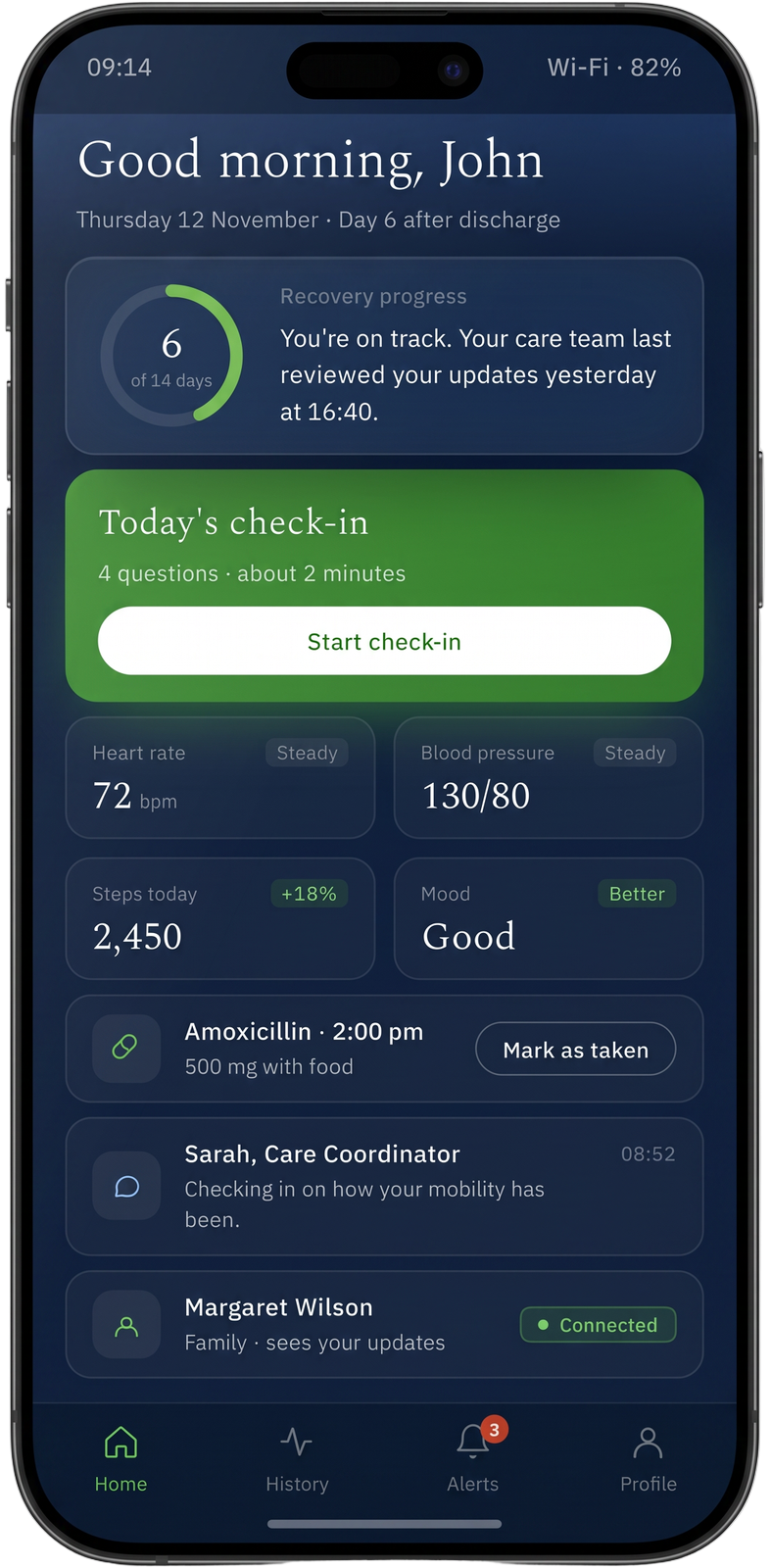
Home
Daily check-in and readings
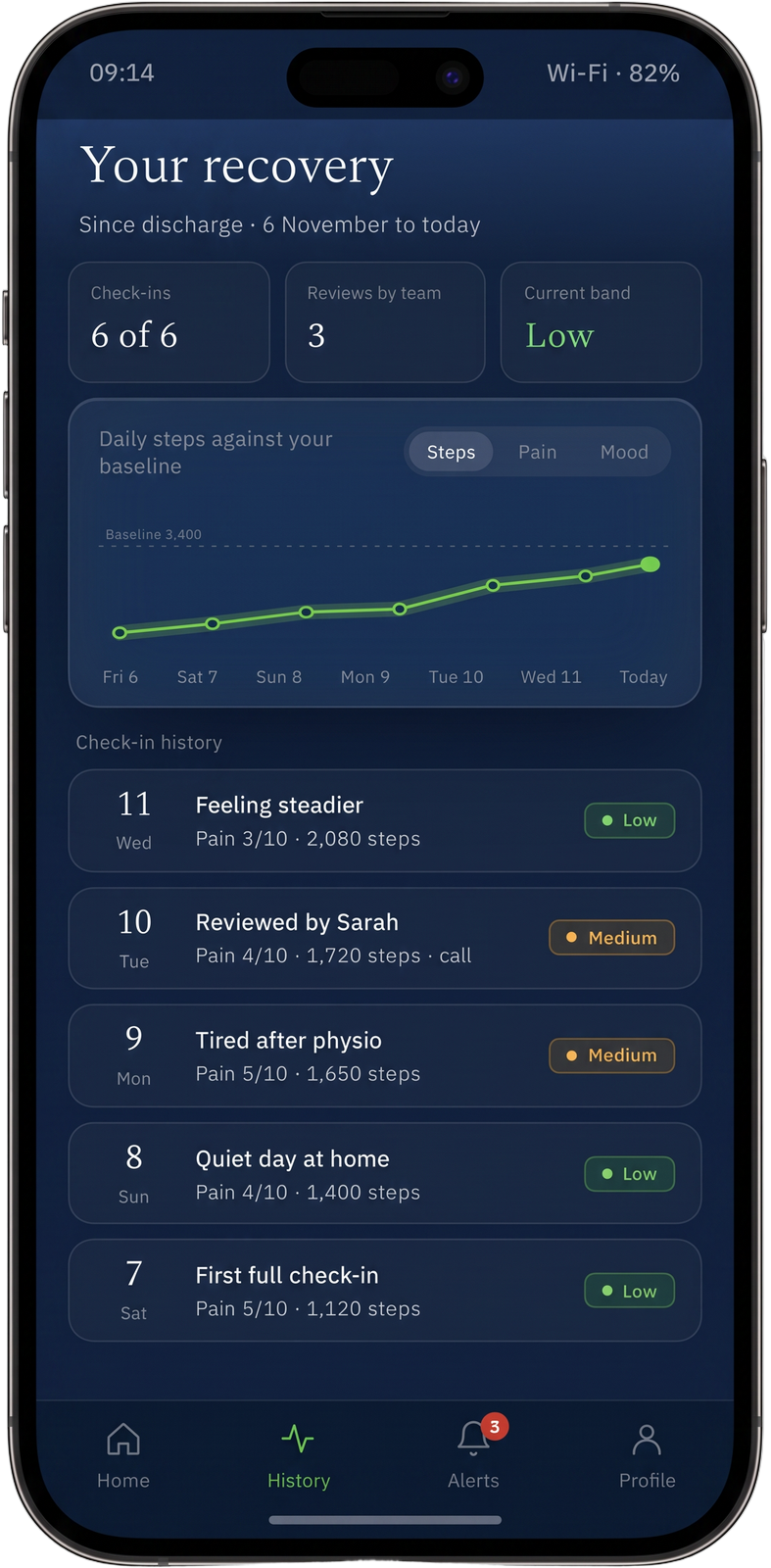
Your recovery
Progress since discharge
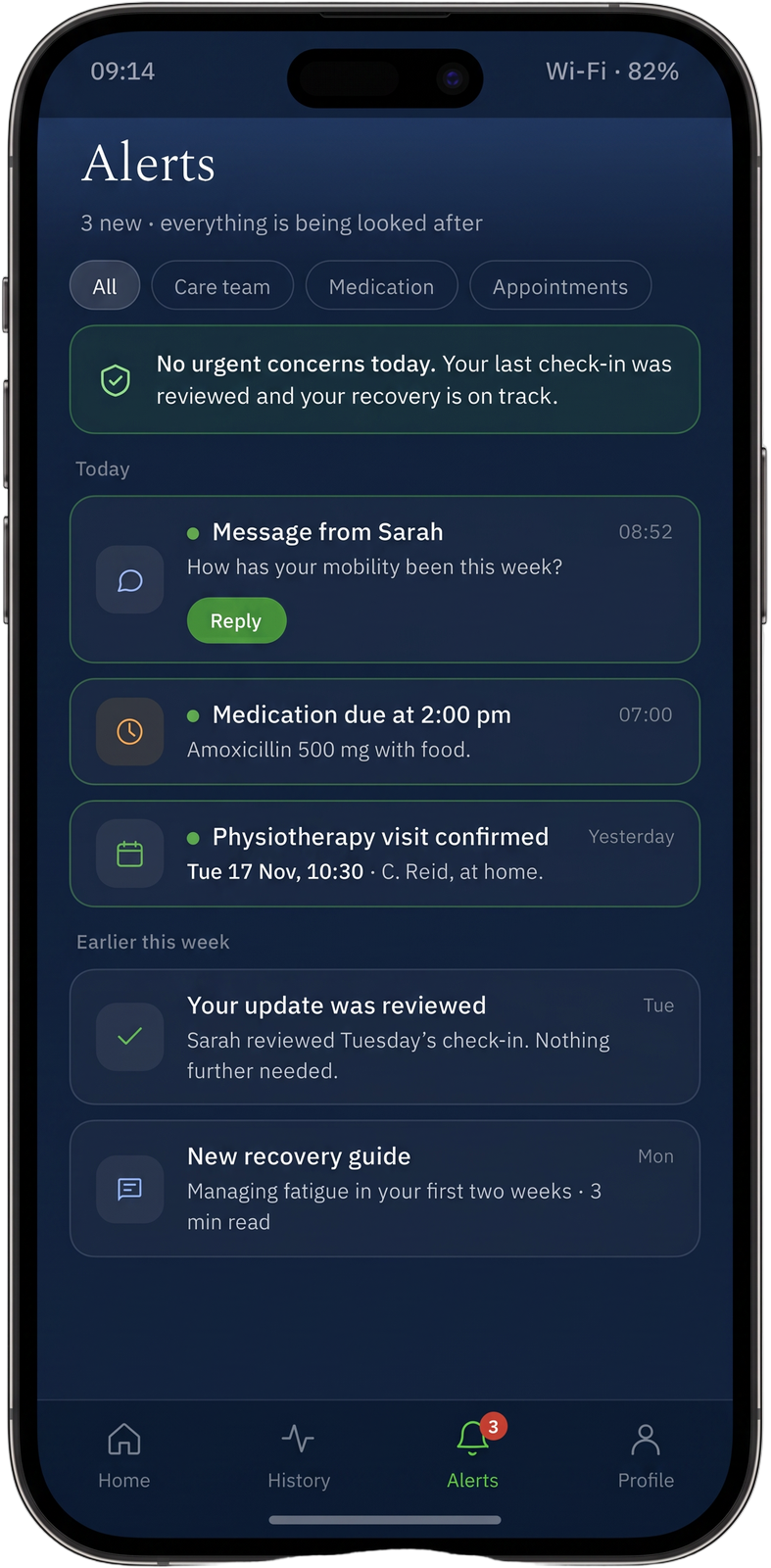
Alerts
Messages and reminders
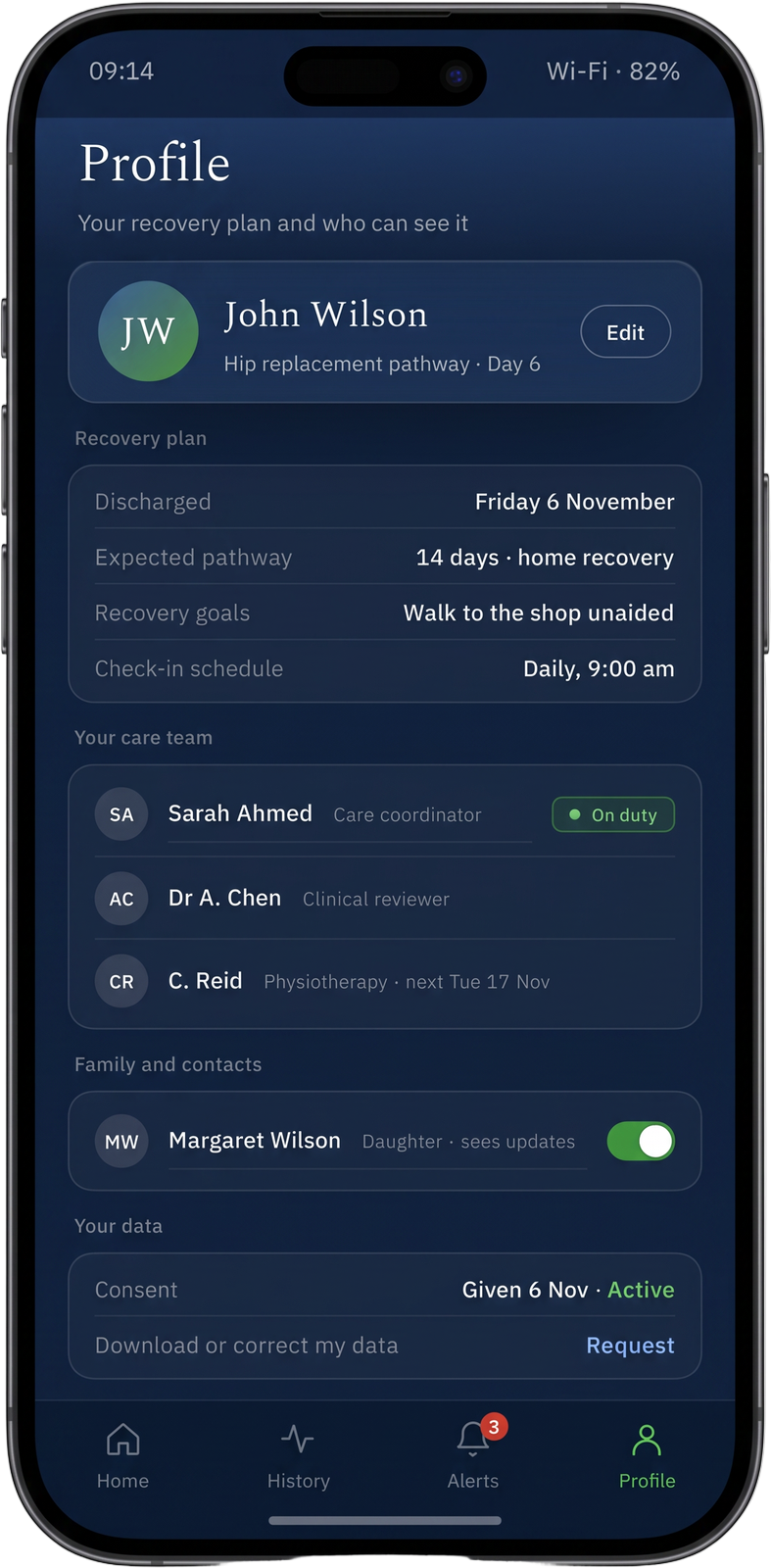
Profile
Care plan and consent
Rules first, evidence second, models only when both support them.
Ambrosia will not present an untrained algorithm as predictive intelligence.

Built in stages, gated by evidence
A twelve-week MVP delivery, then evidence, then models.
Weeks 1–2
Discovery and technical planning
2–15 Nov 2026
Weeks 3–4
Interface design across four portals
16–29 Nov 2026
Weeks 5–8
Core development
30 Nov – 27 Dec 2026
Week 9
PRSO Engine integration
28 Dec 2026 – 3 Jan 2027
Week 10
Testing and quality assurance
4–10 Jan 2027
Week 11
User acceptance testing
11–17 Jan 2027
Week 12
Deployment and handover
18–24 Jan 2027
Phase 1 · Explainable MVP
- Founder-authored PRSO rulebook and decision tables
- Clinically reviewed thresholds and red-flag triggers
- Transparent 0–100 score, risk band and reason codes
- Human review built into every significant action
- Live launch only after safety approval
Phase 2 · Evidence and model development
- Capture consented longitudinal recovery information
- Define outcome labels and prediction horizons
- Link patient signals, interventions and outcomes
- Measure missing data, label quality and potential bias
- Test interpretable candidate models in shadow mode against the rules engine
Phase 3 · Validated predictive intelligence
- Deploy only after performance and safety validation
- Test calibration, accuracy and subgroup performance
- Provide reviewer-visible explanations
- Monitor drift and version changes
- Retain human authority and the rules engine as safeguards
One configurable core, many pathways
The same platform serves individual patients, provider cohorts and NHS pathways without being rebuilt.
Reusable technology core
- PRSO scoring architecture, reason codes and human-review workflow
- Patient, coordinator and partner interfaces
- Outcome-linked audit trail and model-governance framework
- Central security, reporting and performance monitoring
Configurable per market
- Condition-specific questions, thresholds and escalation pathways
- Local languages, consent processes and data-retention requirements
- Approved clinical, community and practical-support providers
- Jurisdiction-specific regulatory requirements
Routes to market
- Direct access for patients and families
- Managed cohorts for care providers and private healthcare organisations
- Controlled pilots with NHS Trusts and Integrated Care Boards
- The same platform serves all three without being rebuilt
18.5 million
finished admission episodes recorded in England, 2024–25
4.3 million
UK residents aged 65 and over living alone
5
documented adviser and partner relationships
Talk to us
If you are a care provider, healthcare organisation, investor, patient or family member, we would like to hear from you.
ambrosia.healthtechcare@gmail.comLime Studio, Dock Road
Birkenhead, Wirral
Merseyside, CH41 1BS
United Kingdom

Care. Innovation. Better health.
Predicting recovery. Connecting care.